
Coming Soon
Scheduled to release on February 12, 2027
From Hubble to LIGO: Instruments and the Making of Knowledge
When the Hubble Space Telescope launched into orbit, the most precisely polished mirror in history came back blurry. Because the device used to test it was wrong. How can anyone be sure an instrument isn't lying?
When the Hubble Space Telescope launched into orbit, the most precisely polished mirror in history came back blurry. Because the device used to test it was wrong. How can anyone be sure an instrument isn't lying? In this episode of reWandt, we deconstruct the five-stage chain from physical sensor interaction to digital display and human interpretation. Drawing on author Simon Winchester's The Perfectionists, NASA's Hubble Optics records, the landmark Advanced LIGO papers (arXiv:1411.4547 and arXiv:1602.03837), and historian Thomas Misa's account of industrial research labs in Leonardo to the Internet, we examine why high repeatability can mask systematic reference errors. We also walk through a practical thermal sensor diagnostic case (22.0°C vs. 20.0°C) to show why a single-point check is not a full calibration curve, and compare quantitative, qualitative, participatory action, and professionally engaged research methods. Explore more deep dives at https://reWandt.com #reWandt #ScientificInstruments #Metrology --- *Disclaimer: Assembled by AI from Professor Wandt's lectures and research; this overview may not reflect his exact views or wording.*
Key Takeaways & Core Ideas
- ▪The Sensor-to-Display Chain: Every readout depends on physical interaction, transduction, signal processing, calibration reference, and interpretation; decimal places do not establish environmental context.
- ▪Repeatability vs. Independence: Hubble's reflective null corrector flaw proves that repeating measurements against a faulty reference reinforces confidence without detecting systematic bias.
- ▪Single-Point Reference Limits: Finding a 2.0°C discrepancy between two sensors at 20.0°C proves disagreement at one benchmark, but does not establish a full calibration curve or rule out physical room changes.
- ▪Methodological Pluralism: Rigorous inquiry pairs quantitative metrics and qualitative process analysis with clear assessment of when participatory action or practitioner engagement is feasible.
Source Excerpt
"When the Hubble Space Telescope launched into orbit, the most precisely polished mirror in history came back blurry. Because the device used to test it was wrong. How can anyone be sure an instrument isn't lying?"
Related Episodes & Topics
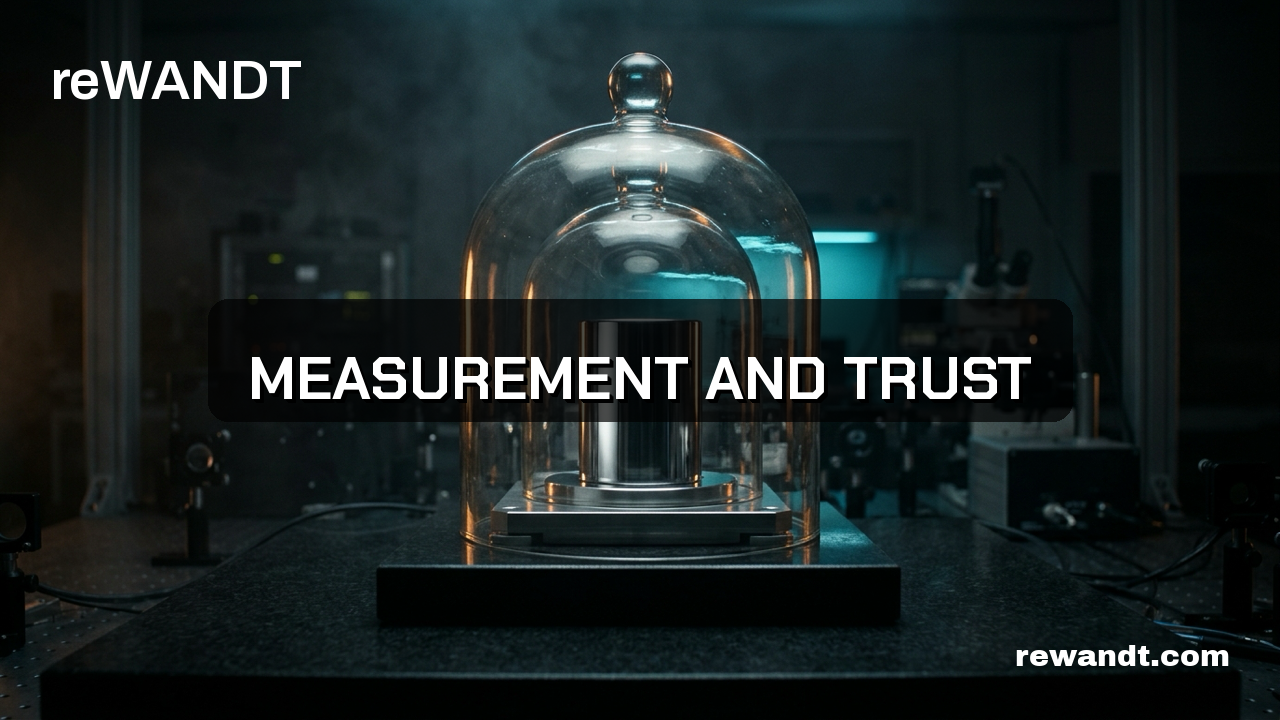
The Architecture of Certainty: Measurement, Standards, and Trust
Two workshops build steel parts to the exact same millimeter blueprint. Yet when the pieces meet, they refuse to fit. Why can a measurement be hyper precise and still completely wrong? In this episode of reWandt, we examine the socio-technical architecture of measurement, standards, and empirical evidence. We explore why bare numbers require explicit units, procedures, and environmental conditions, why raw observations must remain distinct from statistical summaries (mean vs. range), and why missing data must never be recorded as a zero-value event. Anchored in NIST Technical Note 1297, BIPM Resolution 1 (2018), Simon Winchester's The Perfectionists, and Thomas Misa's Leonardo to the Internet, we contrast physical instrument calibration with global telecommunications interoperability and demonstrate how quantitative variation and qualitative process analysis work together. Explore more deep dives at https://reWandt.com #reWandt #Metrology #StandardsAndTrust --- *Disclaimer: Assembled by AI from Professor Wandt's lectures and research; this overview may not reflect his exact views or wording.*